
Being a strategic leader isn’t easy. And to be honest, strategic thinking doesn’t come naturally to everyone. For many, strategy feels overwhelming or inaccessible—something reserved for a select few with MBAs or executive titles. As a result, some shy away from it altogether.
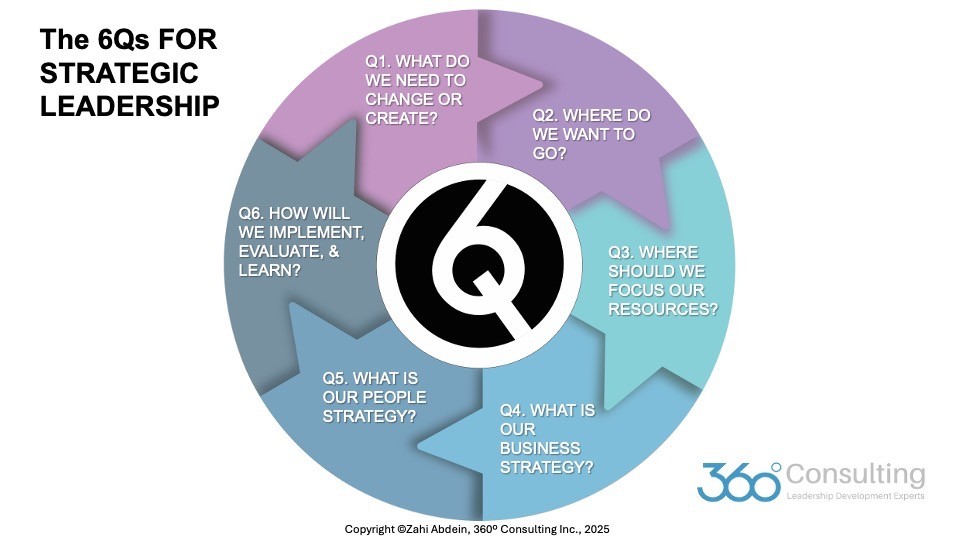
That’s why I created the 6Q’s Framework—six essential questions designed to help leaders at all levels think strategically, systemically, and proactively. These six questions guide the development of strategy in a way that’s practical, human-centered, and easy to communicate across your organization.
Whether you're leading a startup or an established business unit, these questions work across different contexts—organization-wide, at the department level, or for a new initiative. The questions are simple to understand, but not always easy to answer. And that’s the point. Strategic thinking requires wrestling with complexity. But with the right questions, the process becomes more intentional and collaborative.
The real power of the 6Qs lies in their accessibility. They allow leaders to frame strategic conversations clearly with stakeholders at every level. When people understand the "why" and "where we're going," resistance fades, and implementation accelerates. Strategy stops being a document and becomes a shared mindset.
Q1. What needs to be created or changed? Q2. Where do we want to go? Q3. Where should we focus our resources? Q4. What is our business strategy? Q5. What is our people strategy? Q6. How will we implement, evaluate, and learn?
As you move through these questions, remember: you won’t always have the answers right away. Some answers will only emerge through dialogue, exploration, and experimentation. Others will require cross-functional collaboration. You’ll need to revisit these questions regularly as your environment shifts and your organization evolves.
Strategy isn’t static. It’s dynamic, iterative, and deeply human. The 6Qs provide a starting point to build—and keep building—a robust and relevant strategy.
In designing this framework, I drew on several established models, including the Strategic Planning Process, the Center for Creative Leadership’s Strategic Leadership Model, and others referenced throughout this article.
Every strategy begins with disruption—something in your external or internal environment that calls for innovation or reinvention.
For startups, it’s usually about identifying unmet needs in the market and building a product or service to fill that gap. For mature organizations, it’s about staying relevant in a fast-changing world. Markets evolve, customer expectations shift, and technologies disrupt industries daily. To remain competitive—and sustainable—we must continuously assess what needs to be created, changed, or let go.
Q1 requires both external scanning and internal reflection. What trends or disruptions are emerging? What’s no longer serving us? Where are the friction points?
SWOT Analysis – to understand internal strengths and weaknesses, and external opportunities and threats. PESTLE Analysis – to explore political, economic, social, technological, legal, and environmental trends. Porter’s Five Forces – to assess industry competitiveness and identify strategic pressure points.
This first question is about the clarity of context. The rest of your strategy will build on the insights you uncover here.
Once you’ve understood what needs to be created or changed (Q1), you must articulate your destination. What kind of organization are you trying to become? What impact are you aiming to have? What purpose will drive your decisions?
This question explores your vision, mission, and values. It’s about defining your organization’s identity and direction in a way that resonates with both internal and external stakeholders.
What future are we trying to create? What problems are we solving, and for whom? What does success look like in three, five, or ten years? How will we know we’ve made a meaningful difference? What core values will guide us along the way?
The Vision to Values Framework by Jeff Weiner Hoshin Kanri Planning, which links long-term goals to short-term actions
Your purpose, vision, and values must be more than words on a wall—they should guide daily behavior and decision-making.
Strategy without focus is wishful thinking. Every organization has finite resources—money, time, people, and technology. So, where will those resources make the biggest difference?
This question is about prioritization and value creation. Where can you get the most return on investment? Which initiatives will help you move closer to your vision?
VRIO Framework – to evaluate internal resources for competitive advantage BCG Matrix – to prioritize business units or product lines Value Chain Analysis – to identify where value is created (or lost) across your operations
This step requires making tough choices. Not every good idea can be funded. Strategy is just as much about what to say no to as it is about what to pursue.
A business strategy is a cohesive plan that outlines how you’ll achieve your goals, deliver your value proposition, and maintain a competitive edge. It’s the blueprint that turns your vision into reality.
You’ve already done much of the groundwork in Q1–Q3. Now, it’s about integrating those insights into a formal strategy. This includes:
Marketing strategy Financial and investment strategy Operational strategy Technology and innovation roadmap Customer and channel strategies
Business strategy isn’t just about direction—it’s about alignment. Departments must understand how their goals and metrics link to the broader strategy.
To ensure coherence, refer to the first three elements of the McKinsey 7S Framework (Strategy, Structure, and Systems)
Strategy becomes actionable only when it’s cascaded and aligned across the organization.
Culture and people are often mistakenly treated as the 'soft side' of strategy, when in fact, they are foundational to successful execution. Clarifying both the cultural shifts and people capabilities needed is key.
Organizations often overlook people, culture, and leadership when crafting strategy. Why? Because it’s messy. People aren’t predictable. Culture is dynamic. There’s no one-size-fits-all manual.
Yet every strategy depends on people for execution. A strong people strategy bridges the gap between your business goals and your workforce capabilities. You need the right talent, the right culture, at the right time.
Do we have the right people in the right roles? What leadership capabilities are needed? How do we build a culture that supports the strategy? How do we address resistance and lead change?
This question has two dimensions: understanding your current state, and defining what’s needed to succeed. Use frameworks like:
The remaining 4 S’s of McKinsey’s 7S: Skills, Staff, Style, Shared Values Schein’s Organizational Culture Model Cameron & Quinn’s Competing Values Framework Denison Model Hofstede’s Cultural Dimensions
You can’t separate culture from strategy. They’re two sides of the same coin.
This question also calls for reflection on how leadership itself must evolve. Strategy is not just about executing plans; it’s also about who leaders need to become. As environments shift, leaders must adapt, developing new mindsets, behaviors, and ways of relating. This adaptive leadership component is crucial for sustaining long-term strategic impact.
Once your strategy is defined, it needs to move from paper to practice. Implementation requires action plans, timelines, accountability, and performance measures.
Stakeholder engagement planning and change readiness assessment are key to success. Identifying and involving internal and external stakeholders throughout the journey, and also considering plausible future scenarios to remain agile and resilient. Change readiness assessment is where we evaluate organizational capacity and willingness to transform.
Strategy isn’t a one-time event. It’s a living process. You must evaluate progress, learn from feedback, and adjust along the way.
Implementation plans and accountability structures Evaluation methods (formative and summative) Learning loops and feedback mechanisms Change management and communication plans Talent and capability development
Balanced Scorecards OGSM Framework (Objectives, Goals, Strategies, Measures) Three Horizons Model Flight Levels Thinking Power-Interest Grid RACI Matrix Stakeholder Empathy Mapping
Remember: the goal is not perfection. It’s progress. Strategy is not just about delivering results—it’s about learning and adapting as you go.
After working through the 6Qs, you’ll have the foundation for a comprehensive strategy document. This is a working artifact, not a final product. It should evolve based on results, learning, and shifts in the environment.
Executive Summary Vision, Mission, and Values Current State Analysis Strategic Priorities (Value Proposition / Target Markets / Competitive Advantage) Tactics and Action Plans Stakeholder Engagement Plan Scenario Narratives or Strategic Options Cultural/Behavioral Indicators of Change Leadership Development Needs & Plan Change Readiness Assessment KPIs and Measurement Systems Risk and Mitigation Plans Appendices and References
Use this document not just to inform, but to engage. Review it periodically with your teams to reinforce alignment and accountability.
In today’s volatile and fast-changing business environment, strategy is not optional. It’s essential. But strategy doesn’t need to be overly complex or reserved for boardrooms.
The 6Q’s Framework provides a clear, practical way to think—and talk—strategically. It invites leaders to examine their assumptions, connect the dots, and build strategies that are alive, agile, and aligned with purpose.
Whether you’re just starting your strategic journey or revisiting your roadmap, use the 6Qs as your guide. You don’t have to have all the answers—just the courage to ask the right questions.
Thank you, Zahi for sharing this with us. Quite helpful and intriguing. A question that occurs to me: how do you get the client to answer the questions that identify their people and business strategy if they are generally coming to get your support to identify their strategy? Would love to hear your insights. Thanks
This is such a clear and empowering framework, Zahi. I especially appreciate how the 6Qs create space for both business and people strategy, which are too often treated as separate conversations. As someone who works closely with leaders during times of transformation, I see firsthand how these kinds of reflective, structured questions can shift a team from confusion to clarity. Strategy becomes something they co-own, not just something handed down.
Brilliant work, Zahi 👏 Your 6Q’s Framework is a powerful yet practical contribution to how we think and talk about strategy. It’s amazing how you distilled the complexity of strategic planning into six essential, human-centered questions that leaders at any level can use to spark clarity, alignment, and meaningful action.
Most leadership models describe what happens in a room with other people: a team finding common ground, deciding what…
Most organizations are approaching AI the wrong way. They are treating it like a tool to deploy, a system to install…
Why AI Governance Belongs to Leaders in the Boardroom In my earlier article on the 6Qs of Strategic Leadership, I wrote…
In a world where technology evolves at breakneck speed, Zoom has transformed from a pandemic necessity into a visionary…
Leadership is evolving. We no longer consider it as one individual with a strong, authoritarian personality.
In today’s work environment, there’re more demands for leaders than ever; leaders to lead organizations, teams, and…
Immense studies and researches on leadership have been going on for decades. Such endeavors have increased tremendously…
Leadership is an interesting topic to discuss and explore, but identifying and developing one’s own style of leading is…
Roland Heifetz and Marty Linsky introduce a rather witty metaphor, Balcony and the Dance Floor, in their book…
Are you a good manager? How do you know? Being a good manager is easier said than done. Some, enjoy holding the title…