
Most leadership models describe what happens in a room with other people: a team finding common ground, deciding what to do, and getting it done together. That part of the story is real, and it has been studied well. What's missing from most of it is what happens before anyone walks into that room, and what happens after the meeting ends, when the results, good or disappointing, are sitting there waiting to be reckoned with.
I have spent the better part of two decades working with executives, boards, and high-potential leaders across very different organizations, sectors, and cultures, as a consultant, coach, facilitator, and associate faculty member with several leadership development institutions. Across all of it, I kept running into the same gap. The frameworks I worked with most treated leadership as a process, a set of behaviors, something a group achieves together. They were clear, well-tested, and useful. But they tended to start in the middle of the journey, with people already in the room, and they stopped at the result, with no path back to the leader who set things in motion in the first place. The advice built on top of those frameworks was good advice, and it still left a quieter question unanswered: where does any of this start, and what happens to the leader once the result, whatever it turns out to be, actually lands?
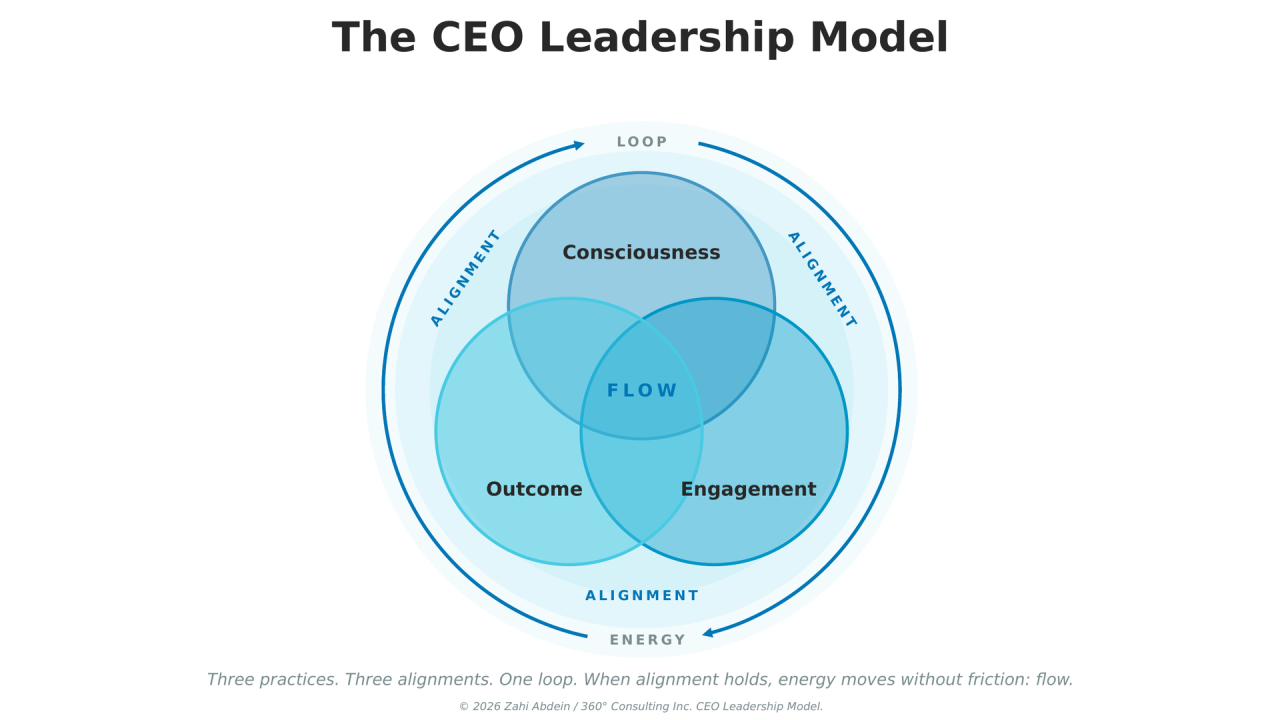
I built a model to close that gap. I call it the CEO Leadership Model, not after the job title, but after what the three letters stand for, C-E-O: Consciousness, Engagement, Outcome.
Three practices. Three alignments. One loop. When alignment holds, energy moves without friction: flow.
A few words in that sentence are doing real work, and they were chosen carefully.
“Practice,” not capacity or trait. Leadership is something you do, repeatedly, and through the doing, something you become. The practice shapes the practitioner. People vary in how naturally it comes to them, and that variation is fine; it's a practice, and a mindset, precisely because it can be built over time, not a fixed quality some people are born with and others aren't. Run the practice consciously, again and again, and it compounds into who you are as a leader. Doing, sustained with awareness, becomes being.
“Oneself, others, and systems,” because leadership that only accounts for the people directly in front of you misses the teams, organizations, and wider systems your decisions ripple into, and that impact you in turn.
“Intended results,” not desired or ideal results, because the model is deliberately neutral about what counts as a good outcome. That judgment depends on context, values, and the situation at hand, and it isn't the model's job to make it for you. What the model does require is intention. You can fail to get the result you were aiming for and still have been leading. You cannot stumble into leadership by accident.
That distinction matters more than it might first appear. A manager who reorganizes a team without thinking it through and gets lucky was not leading in this sense, even if the numbers improved. A junior employee with no formal authority who consciously, deliberately works to shift how their team approaches a problem is leading, fully, even if the attempt falls short. Authority is not the test. Consciousness is.
That idea connects to something I've believed for a long time, the foundation the rest of the model is built on: leadership begins from within. True leaders influence and motivate not only others but also themselves to learn and grow. That's where the inner work is most important. Before anyone can direct a team, they first have to direct themselves, their attention, their energy, their own choices. That is where the model starts, and it is also where most leadership conversations, focused entirely on behavior toward others, leave a gap.
The CEO model has three stages, in a specific order, but it is not a straight line. It is a loop. And while you are in it, something real moves through it: attention and energy, the very things the definition says leadership directs.
Consciousness comes first: the internal work of self-knowledge, values, and the deliberate choice to lead. This is the stage that separates leadership from accidental influence. A leader walking into a difficult conversation with a clear read on their own motives and blind spots is operating at this stage; one who walks in reacting, without having asked what they actually want from the exchange, is not, regardless of how the conversation turns out. Consciousness also asks for an honest read of your own capacity, since that capacity isn't fixed or equal across people. It can be developed and grow. The model doesn't ask for a finished version of yourself, only an aware one. Consciousness also shows up in the body. Presence, being physically, mentally, and emotionally in the room rather than half-elsewhere, is how an inner state becomes something others can feel and respond to; it is the point where inner work stops being private. This is also where energy is sourced: a leader who knows what they want, and why, and who is fully present, brings a different quality of energy into the room than one running on reaction.
Engagement comes second: the active, two-way work of moving people toward a purpose, and being moved by them in return. It begins with presence, the same presence Consciousness asks for, now turned outward, since you cannot genuinely engage people you are not fully in the room with. I'm careful to call this engagement instead of influence, because influence describes something one person does to another, a one-way action. Engagement describes something two people, or a leader and a system, do together. A common purpose isn't assumed at the start of this stage; it's earned, or it isn't, through the engagement itself, often through the harder, slower work of listening, gathering feedback, and adjusting rather than simply announcing a decision and expecting it to land. This is where energy is exchanged: offered, returned, sometimes resisted, never simply transmitted.
Outcome comes third, and this is where most leadership models stop. This one doesn't. What results, for the leader, for others, and for the systems they're part of, feeds back into the leader's own consciousness, and the loop begins again. A leader who reads a disappointing result honestly, and lets it change how they show up next time, feeding their own development, growth, and learning, is still in the loop. One who explains the result away and repeats the same approach has, in effect, stepped out of it. Outcomes aren't an endpoint. They are the raw material for the next round of awareness, the next decision, the next engagement, the next attempt. This is also where energy comes back: renewed by a result honestly faced, or drained by one explained away.
A note on those three stages before going on. Calling Consciousness inner, Engagement interpersonal, and Outcome systemic marks where each one begins, not a fence around it. Each runs across all three levels: you can be conscious of yourself, of others, and of the wider system; you engage yourself, other people, and the structures around you; and outcomes land on you, on others, and on the system alike. The names point to the home of each stage, not its limit.
The loop- Consciousness shaping Engagement, Engagement producing Outcome, Outcome reshaping Consciousness- is the whole model in action. But a loop can close and still grind. What determines whether it runs clean is alignment.
Alignment is not a fourth stage. It is the connective condition of the whole loop, and it operates at the same three levels as the definition itself. Aligned within yourself: motives, values, and choices pointing the same way, the honest work of Consciousness. Aligned with others: a purpose actually shared rather than imposed, the earned work of Engagement. Aligned with the systems around you: results read honestly and fed back, the unfinished work of Outcome. Where alignment holds, energy moves through the loop free of friction. Where it breaks, the energy leaks, and you can usually name the leak: politics, rework, second-guessing, quiet disengagement.
When alignment holds at all three levels, and the loop keeps closing cleanly, leadership can enter a state worth naming on its own: flow. Positive energy moves outward from the leader, and positive energy comes back. The three ideas are one system: the loop is the circuit, energy is what moves through it, and flow is what the system feels like when nothing is leaking. Flow is not the default condition of leadership, and it is difficult to sustain in a fast-moving, uncertain world. It is also not something a leader produces by will alone. It depends on conditions outside any one person: a leader's own resilience, a psychologically safe environment, a healthy system or culture around them. Leadership doesn't happen in a vacuum, and flow is usually what it looks like when those internal and external conditions line up, not just a function of individual effort. It is a real human possibility, not just an aspiration, available to anyone willing to keep the loop conscious and engaged, and to do the harder work of building the alignment and the conditions that make it possible, rather than letting any one stage run on autopilot.
Here is where the model has to earn its keep in practice, not just hold up on a page.
I wanted a clear way to answer a question leaders ask me constantly, in different words, across very different settings: how do I know if I'm actually leading, or just keeping things moving? Other frameworks answer a related but different question: did the group end up doing, together, what it set out to do. That's a useful test, but it isn't the right one for a model built on intention rather than achievement, since this model holds that leadership is defined by the intention and the attempt, not by whether the intended result actually landed.
Did the outcome, whatever it turned out to be, actually feed back into your awareness and behavior, changing how you read the situation and what you do next, or did you ignore it and keep operating exactly as before?
A yes to all three means leadership is happening, and the leader is growing with it. The result you were aiming for still matters; it's the whole reason for making the attempt, but on its own it doesn't tell you whether you were leading. A no to any one of the three means something else was happening: managing, commanding, or simply getting lucky. Useful things, sometimes. But not leadership, by this definition.
I use a version of this test in coaching conversations and in talent assessment work, because it gives a vague, abstract idea something concrete to be measured against. It also tends to surface the right next question for someone who answers no, usually not “try harder,” but “go back to consciousness,” since that is almost always where the gap began. And when the loop is closing but leading still feels heavy, the sharper question is the energy question: where is it leaking? The answer nearly always points to the level, self, others, or systems, where alignment has broken.
I did not build this model to compete with anything. I built it because the leaders I work with, in boardrooms, in government institutions, in organizations moving through real and difficult change, keep asking some version of the same question, and existing language wasn't giving them a clean way to answer it.
It also travels better than a purely group-based model across the range of organizational cultures I work in. Some of the leaders I coach operate in flat, highly consultative environments where decisions move slowly and by consensus; others operate in more hierarchical organizations where a single leader is expected to decide and own the outcome. A model that starts inside the individual leader, before assuming anything about how authority or consensus works around them, holds up reasonably well in both. I'd still call that a working hypothesis rather than a settled conclusion, something I'll keep testing as I use the model over various settings, not a claim I'm making with full confidence yet.
The honest answer, I've come to believe, is that you find out by checking the loop, not the scoreboard. Were you conscious about what you were doing? Did you actually engage the people around you, not just direct them? And when the result came in, whatever it turned out to be, did it change you?
That is the practice. Not a title, not a personality, not a finished state you arrive at once and then keep forever. A loop you keep returning to, with a little more awareness each time around, and, over time, a different leader running it.
Every leader, with or without the title, is the CEO of their own leadership. The question worth asking isn't whether you have the authority. It's whether you're running the loop, and what kind of energy you're putting through it.
Most organizations are approaching AI the wrong way. They are treating it like a tool to deploy, a system to install…
Why AI Governance Belongs to Leaders in the Boardroom In my earlier article on the 6Qs of Strategic Leadership, I wrote…
In a world where technology evolves at breakneck speed, Zoom has transformed from a pandemic necessity into a visionary…
The 6Qs Framework: A Practical Guide to Building Winning Strategy Being a strategic leader isn’t easy. And to be…
Leadership is evolving. We no longer consider it as one individual with a strong, authoritarian personality.
In today’s work environment, there’re more demands for leaders than ever; leaders to lead organizations, teams, and…
Immense studies and researches on leadership have been going on for decades. Such endeavors have increased tremendously…
Leadership is an interesting topic to discuss and explore, but identifying and developing one’s own style of leading is…
Roland Heifetz and Marty Linsky introduce a rather witty metaphor, Balcony and the Dance Floor, in their book…
Are you a good manager? How do you know? Being a good manager is easier said than done. Some, enjoy holding the title…