
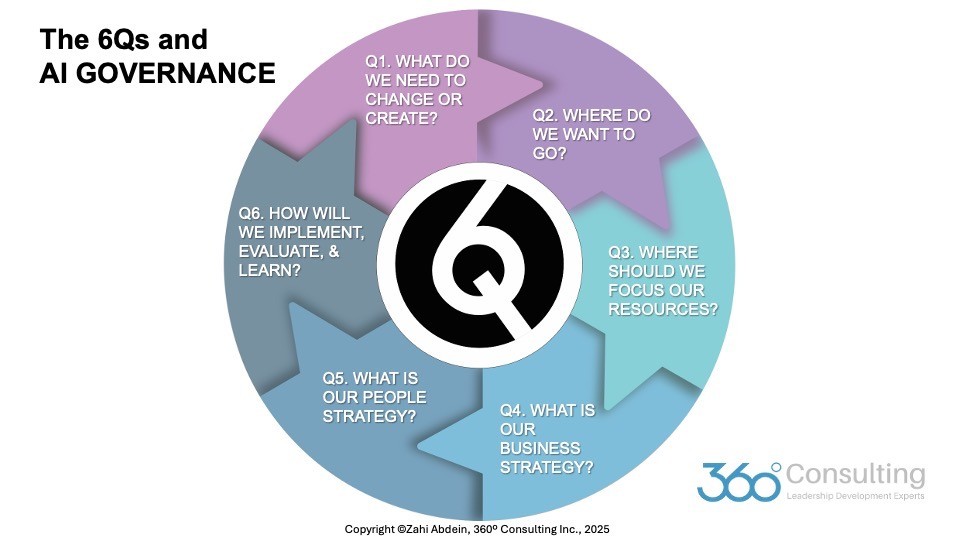

In my earlier article on the 6Qs of Strategic Leadership, I wrote that strategy does not need to be overly complex for leaders to understand and execute. It needs structure. More specifically, it needs the right questions.
Today, many organizations are AI-aware. They are talking about AI, exploring tools, and running pilots. But far fewer are truly AI-enabled in a strategic, governed, and value-creating way.
This is not about introducing a new framework. It is about applying an existing framework to one of the most important leadership and governance challenges facing Boards and executive teams today.
Because AI governance is not just a technology issue. It is a leadership issue. A strategy issue. And ultimately, a human issue. It asks not only what AI can help us do, but how we want to lead, what we want to protect, and what kind of organization we are becoming in the process.
When that happens, AI often gets pushed into the technology function, measured through pilots and tool launches, and disconnected from real business value. The organization becomes busy with AI, but not necessarily better because of it.
The real question is not simply, “What tools should we use?” The better question is, “Where can AI improve decision-making, strengthen resilience, create value, and help us stay relevant, while still honoring the human judgment, trust, and responsibility that leadership requires?”
An AI-aware organization experiments. An AI-enabled organization has clearer priorities, stronger governance, better capability, and a more deliberate link between AI and business outcomes. Just as importantly, it remains thoughtful about people. It understands that performance and profitability matter, but they should not come at the expense of humanity, trust, or responsible leadership.
The 6Qs provide Boards with a practical lens for asking better questions and governing the transition more thoughtfully.
What is changing in our market, operating model, customer expectations, or cost structure because of AI? What assumptions are no longer safe? What needs to be redesigned, not just automated?
Too many organizations start with the tool. Boards should start with the tension.
Before organizations decide how to use AI, they need to be clear about who they want to become while using it. This is where direction, purpose, and values come back into sharp focus.
What does becoming AI-enabled actually mean for our organization? Are we trying to improve decision speed, customer experience, risk management, innovation, or productivity? What future are we trying to create? What do we want to be known for? And just as importantly, what do we refuse to compromise along the way?
This is also where organizations need to revisit and define their values and purpose for the AI era. More than ever, leaders need to make sure that people and humanity are not overlooked in the pursuit of performance and profitability.
AI enablement should not be framed only as a race for efficiency. It should be linked to the kind of institution the organization intends to become and the standards by which it wants to be trusted.
Without clarity here, AI efforts remain fragmented. They may create movement, but not necessarily meaning, coherence, or confidence.
Not every AI use case deserves attention or investment. Boards need to help management focus on high-leverage opportunities, not “efficiency theater.”
This also means looking beyond technology. Investment in AI must include leadership capability, reskilling, role redesign, and change readiness.
The question is not only where AI can create value, but whether the organization is investing enough in the people who will need to live with, lead through, and make wise use of that change.
AI becomes strategic only when it is directly tied to how the business creates value.
Boards should ask whether AI initiatives are improving important decisions, reducing cost-to-serve, increasing growth potential, or strengthening competitive advantage.
But they should also ask a quieter question: are we using AI in ways that deepen the quality of our decisions, or are we becoming overly dependent on speed at the expense of reflection and judgment?
AI should not sit outside the business strategy; otherwise, it will probably become just an experiment. If it sits outside the organization’s values, it may become something even riskier.
AI changes more than processes. It changes roles, expectations, leadership demands, and culture. That means the people side of strategy becomes critical.
Do leaders have the judgment to use AI well? Is the culture ready to adapt? Are people being supported through the change, or left to quietly fear becoming obsolete? Are we helping our employees reskill for today and the future, or leaving them to figure things out on their own?
The success of AI depends as much on human readiness as on technical capability.
Organizations that navigate this well will not treat people as obstacles to transformation. They will treat them as central to it. They will understand that trust, communication, emotional intelligence, and ethical judgment are not soft issues on the edge of AI strategy. They are part of what makes responsible AI possible.
Boards should expect clear accountability, feedback loops, and the ability to adapt quickly. AI is not a one-time rollout. It is an ongoing capability that requires learning, adjustment, and oversight.
And in that progress, boards and leaders need space to reflect on what is working not only commercially, but also culturally and ethically. They need to ask whether the change is strengthening the business while also building trust, confidence, and clarity among people inside and outside it.
When Boards and C-suite leaders use the 6Qs well in governing AI, they are more likely to secure four important benefits:
1. Better prioritization The 6Qs help leaders focus on the AI opportunities that matter most, instead of chasing noise.
2. Smarter capital allocation They encourage investment not only in tools, but also in people, leadership, and organizational readiness.
3. Stronger risk governance They bring ethical oversight, accountability, and trust into the conversation early, not as an afterthought.
4. Clearer accountability They help ensure that AI outcomes are owned by business leaders, not left only with technical teams.
People at all levels are at the center stage of AI implementation. It will reduce stress and anxiety caused by the fear of AI. As a result, trust is built, and resistance to change is minimized.
Boards do not need to become technical experts in AI. But they do need to become better governors of its strategic implications.
That means making AI a recurring Board-level conversation. It means testing whether the organization is moving beyond awareness into true enablement. It means asking tougher questions about value, risk, capability, and leadership readiness.
It also means asking whether enough attention is being paid to people. Are leaders creating clarity? Are they building trust? Are they helping the organization adapt in a way that is responsible as well as effective?
Is the Board itself prepared to oversee this shift with enough confidence, judgment, and foresight?
In the original 6Qs article, I wrote that leaders do not need to have all the answers right away. They need the courage to ask the right questions.
The organizations that become future-ready will not simply be the ones that adopt AI fastest. They will be the ones who govern it most wisely, use it most thoughtfully, and stay clear about the human values they want to preserve as they evolve.
seeing AI pilots stall at Q6. most boards want frameworks but freeze at actual implementation.
Most leadership models describe what happens in a room with other people: a team finding common ground, deciding what…
Most organizations are approaching AI the wrong way. They are treating it like a tool to deploy, a system to install…
In a world where technology evolves at breakneck speed, Zoom has transformed from a pandemic necessity into a visionary…
The 6Qs Framework: A Practical Guide to Building Winning Strategy Being a strategic leader isn’t easy. And to be…
Leadership is evolving. We no longer consider it as one individual with a strong, authoritarian personality.
In today’s work environment, there’re more demands for leaders than ever; leaders to lead organizations, teams, and…
Immense studies and researches on leadership have been going on for decades. Such endeavors have increased tremendously…
Leadership is an interesting topic to discuss and explore, but identifying and developing one’s own style of leading is…
Roland Heifetz and Marty Linsky introduce a rather witty metaphor, Balcony and the Dance Floor, in their book…
Are you a good manager? How do you know? Being a good manager is easier said than done. Some, enjoy holding the title…