

They are treating it like a tool to deploy, a system to install, or a capability to “add on.” They appoint an AI head, launch a few pilots, and expect transformation to follow.
It rarely does because AI transformation is not a technology rollout. It is a leadership challenge.
And the organizations that are getting it right are not asking, “How do we use AI more?” They are asking, “How does work fundamentally change when humans and AI perform together?”
This is where leadership shifts from awareness to enablement, and it starts at the top.
AI integration cannot be delegated. Not to IT. Not to innovation teams. Not to a newly created “AI function.”
It requires direction, alignment, and accountability at the highest level, cascaded down. Boards and executive teams must define not only what AI can do, but what kind of organization they intend to become because of it, and how people will play a role in it.
This is where governance matters, and that’s why it’s important to use structured frameworks such as the “6Qs of Strategic Leadership” so leaders can move beyond experimentation toward intentional transformation:
What must change? Where are we going? What do we prioritize? How do we compete differently? What capabilities do we build? How do we execute and learn?
Without this clarity, AI becomes fragmented, reactive, and often resisted. With it, AI becomes integrated, purposeful, and scalable. But governance alone is not enough.
AI does not create value on its own. Value is created when human judgment and machine capability are intentionally combined. This requires redesigning how people work, not just introducing new tools.
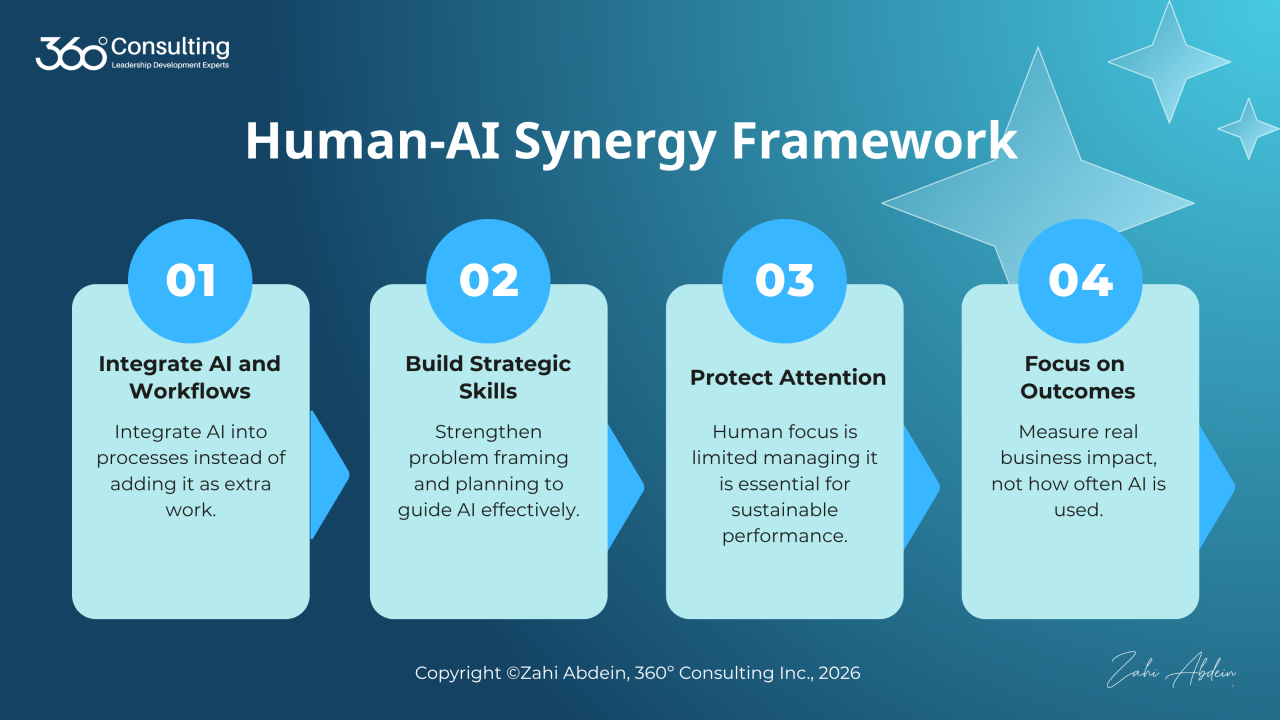
The Human–AI Synergy Framework provides a practical approach to enabling AI integration.
Most organizations are layering AI on top of existing processes. That creates more work, not less. AI should not sit beside your workflows; it should reshape them.
Where does AI remove friction? Where does it accelerate decisions? Where does it augment human insight?
More importantly, it requires redefining roles. Not in terms of replacement, but in terms of collaboration.
When this balance is unclear, employee resistance grows. Maybe not because people reject AI, but because they don’t understand their place within it.
These are activity metrics—not impact metrics. AI should be evaluated based on outcomes:
Better decisions Faster execution Improved customer experience Reduced cost-to-serve Higher-quality outputs
This requires leaders to clearly define what success looks like, how work is expected to change, and what “good” performance means in an AI-enabled environment
When expectations are unclear, people default to old ways of working or use AI superficially to meet perceived or minimal expectations. Rewarding desired outcomes, not usage, will change behavior.
AI does not eliminate the need for human capability; it should raise the bar for reskilling and growth. Employees are no longer just executing tasks; they are guiding systems.
Problem framing Ideation and critical thinking Structured planning Decision-making under uncertainty
These are not technical skills. They are leadership skills at every level. Organizations that invest only in AI tools, but not in people, will underperform because the quality of AI output is directly linked to the quality of human input.
Therefore, coaching, mentoring, and continuous learning become more essential as strategic priorities. Leaders must stay close to their people during this transition to build confidence, reduce anxiety, and reinforce direction.
This is one of the most underestimated risks in AI transformation. As access to information increases, our focus as humans decreases. And without focus, performance suffers.
The difference lies in how work is designed and how attention is managed. Therefore, Leaders must treat attention as a key resource.
Reducing unnecessary noise Designing workflows that prioritize deep work Encouraging habits that support sustained focus Setting boundaries around always-on responsiveness
Because judgment, creativity, and strategic thinking, all the things we expect humans to do in an AI-enabled world, require mental space.
Organizations struggling with AI often fall into the same trap: they look for a single owner, a person, a function, or a team, to carry the responsibility. But AI enablement doesn’t live in one place; it sits with every leader.
Every decision-maker is now accountable for how AI is integrated into their domain, how their teams adapt and perform, and how value is created and measured. This requires a fundamental shift—from “I have an AI team supporting me” to “I am responsible for AI enablement in my area.” At the same time, this transformation cannot be purely top-down. It depends on insights from those closest to the work. Leadership’s role is to align direction with reality—bridging strategy and execution, ambition and capability.
At a deeper level, AI forces organizations to confront a more difficult question: what do we stand for in an AI-driven world? The trade-offs are real: speed versus quality, efficiency versus employment, automation versus human judgment, and they are not technical decisions, but value-based ones.
AI will not transform your organization on its own, but it will reveal the strength of your leadership. And ultimately, success will belong to those who take responsibility for how humans and AI create value together.
well said 💯 . the harder part is not the tech, it’s getting leadership to rethink how work flows.
Yes! AI Enablement is more about people and process, than technology. And unless the leaders make it about shifting mindsets, AI enablement cannot succeed
Spot on, Zahi! This reminds me of the importance of connecting AI objectives explicitly to business strategy, not just technology. 🎯
Most leadership models describe what happens in a room with other people: a team finding common ground, deciding what…
Why AI Governance Belongs to Leaders in the Boardroom In my earlier article on the 6Qs of Strategic Leadership, I wrote…
In a world where technology evolves at breakneck speed, Zoom has transformed from a pandemic necessity into a visionary…
The 6Qs Framework: A Practical Guide to Building Winning Strategy Being a strategic leader isn’t easy. And to be…
Leadership is evolving. We no longer consider it as one individual with a strong, authoritarian personality.
In today’s work environment, there’re more demands for leaders than ever; leaders to lead organizations, teams, and…
Immense studies and researches on leadership have been going on for decades. Such endeavors have increased tremendously…
Leadership is an interesting topic to discuss and explore, but identifying and developing one’s own style of leading is…
Roland Heifetz and Marty Linsky introduce a rather witty metaphor, Balcony and the Dance Floor, in their book…
Are you a good manager? How do you know? Being a good manager is easier said than done. Some, enjoy holding the title…